China leads the world in solar PV deployment, yet the solar tracking systems has been adopted at a relatively low speed at just 12%, compared to around 90% in the United States. What explains this stark contrast in technology choices, and what consequences might follow?
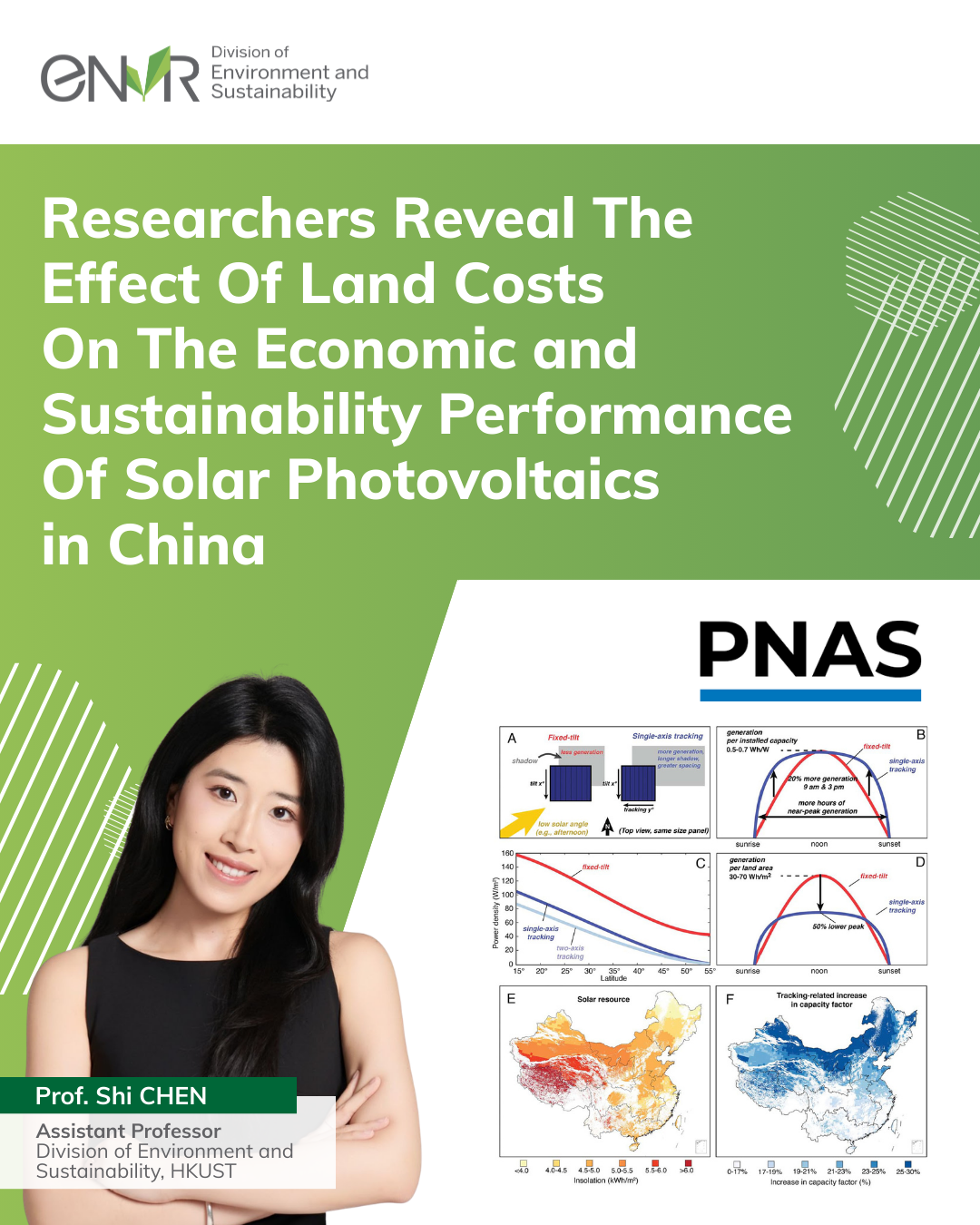
Prof. Shi CHEN, Assistant Professor of Division of Environment and Sustainability and CCRS member, HKUST, together with scholars from Stanford University, Carnegie Science, and Tsinghua University, investigated how land economics and policy shape renewable technology deployment in China.
Their study, titled “The effect of land costs on the economic and sustainability performance of solar photovoltaics in China”, has been published in The Proceedings of the National Academy of Sciences (PNAS).
The study uncovers critical trade-offs between energy yield, land use, and material demand across different tracking technologies. The findings provide new insights to support more balanced, informed, and resilient decarbonization strategies in China and beyond.
Check out the full article here: https://www.pnas.org/doi/10.1073/pnas.2512930123