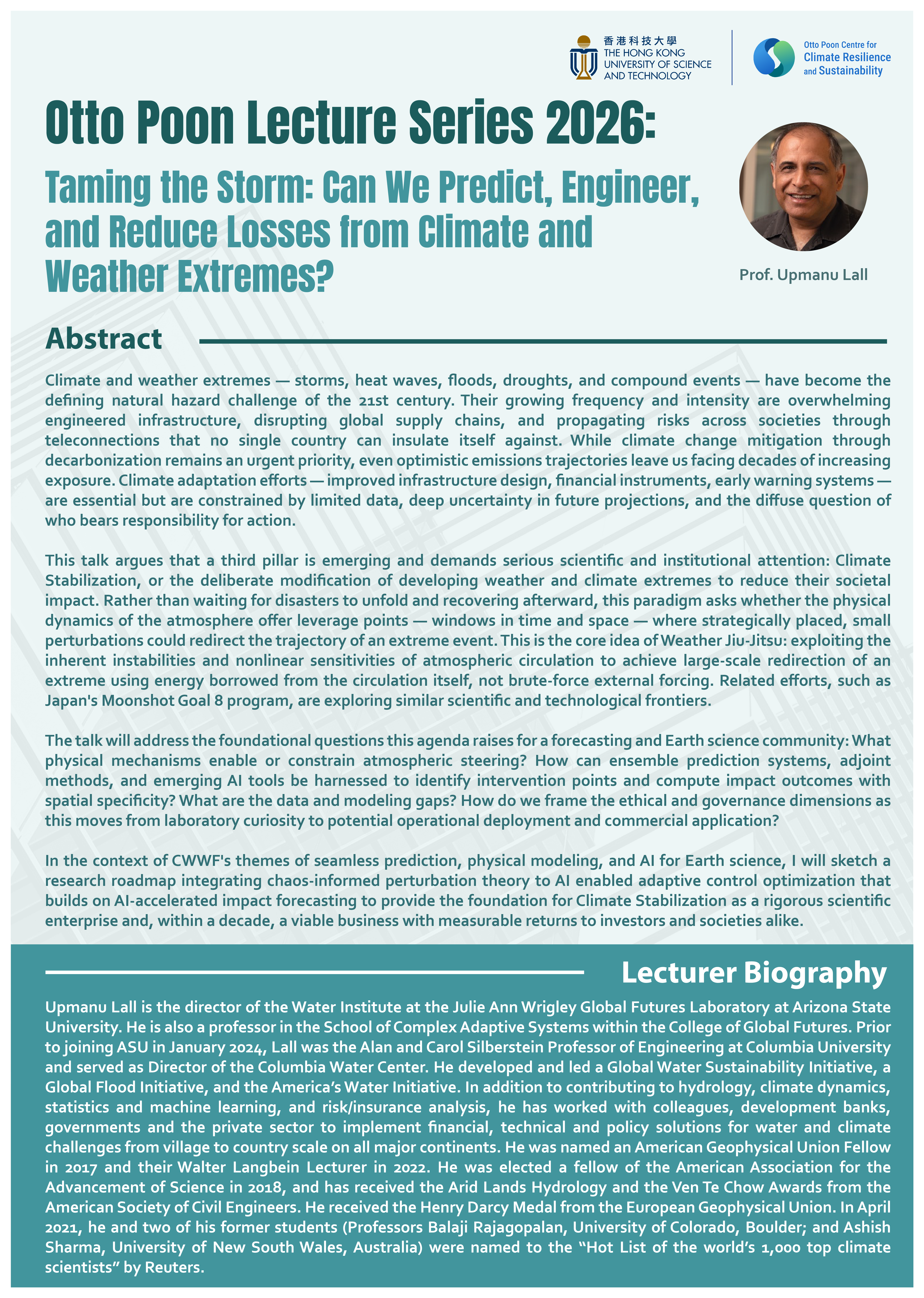
Lecture Series

Taming the Storm: Can We Predict, Engineer, and Reduce Losses from Climate and Weather Extremes?
Lecturer: Prof. Upmanu Lall
Date & Time: 2026/07/09 (Thur.)9:10am - 10:30am
Location: Lecture Theater C, Academic Building, HKUST

On the morning of July 9 (Thursday), Day 3 of the 6th Climate, Weather and Water Forum (CWWF 2026) at Lecture Theater C, HKUST, the Otto Poon Lecture Series 2026 will take center stage, featuring Prof. Upmanu Lall, Director of the Water Institute at Arizona State University's Julie Ann Wrigley Global Futures Laboratory.

Prof. Lall will introduce a provocative "third pillar" of climate action beyond mitigation and adaptation: Climate Stabilization—the deliberate modification of weather and climate extremes to reduce societal impact. Drawing on the concept of "Weather Jiu-Jitsu," he will explore how strategically placed, small perturbations could exploit atmospheric instabilities to redirect extreme events, borrowing energy from the circulation itself rather than relying on brute-force external forcing.

The lecture will address foundational questions: What physical mechanisms enable atmospheric steering? How can AI and adjoint methods identify intervention points? And how should ethical and governance frameworks evolve as this moves toward operational deployment?

Prof. Lall will outline a research roadmap integrating chaos-informed perturbation theory with AI-enabled adaptive control optimization, envisioning Climate Stabilization as both a rigorous scientific enterprise and a commercially viable endeavor within a decade.

Prof. Lall is an AGU Fellow, AAAS Fellow, and Henry Darcy Medal recipient, named among Reuters' world top 1,000 climate scientists in 2021.
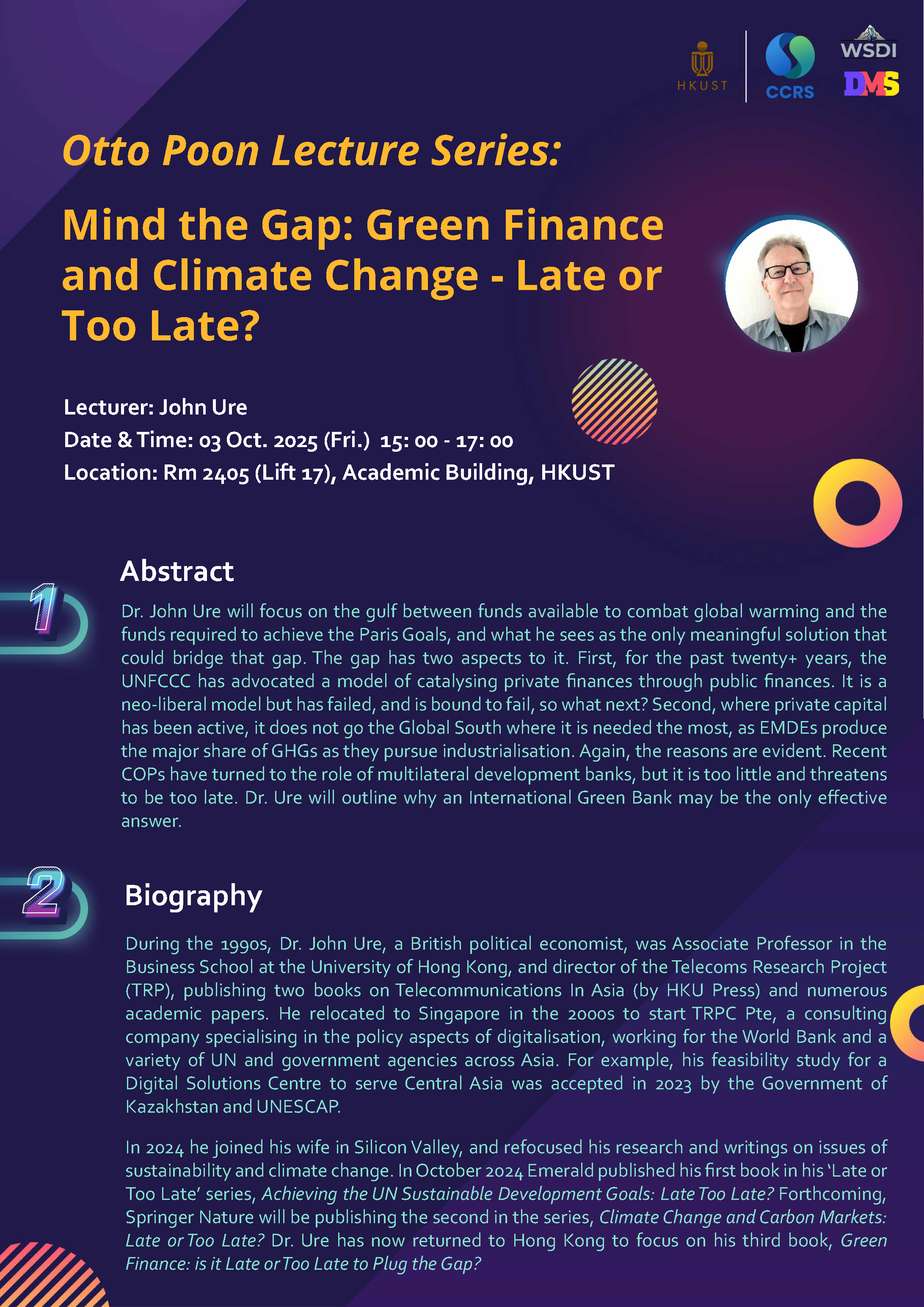
Mind the Gap: Green Finance and Climate Change - Late or Too Late?
Lecturer: Dr. John Ure
Date & Time: 2025/10/03 (Fri.)3:00pm - 5:00pm
Location: Rm2405 (Lift 17), Academic Building, HKUST

Abstract

Dr. John Ure will focus on the gulf between funds available to combat global warming and the funds required to achieve the Paris Goals, and what he sees as the only meaningful solution that could bridge that gap. The gap has two aspects to it. First, for the past twenty+ years, the UNFCCC has advocated a model of catalysing private finances through public finances. It is a neo-liberal model but has failed, and is bound to fail, so what next? Second, where private capital has been active, it does not go the Global South where it is needed the most, as EMDEs produce the major share of GHGs as they pursue industrialisation. Again, the reasons are evident. Recent COPs have turned to the role of multilateral development banks, but it is too little and threatens to be too late. Dr. Ure will outline why an International Green Bank may be the only effective answer.

Lecturer Biography

During the 1990s, Dr. John Ure, a British political economist, was Associate Professor in the Business School at the University of Hong Kong, and director of the Telecoms Research Project (TRP), publishing two books on Telecommunications In Asia (by HKU Press) and numerous academic papers. He relocated to Singapore in the 2000s to start TRPC Pte, a consulting company specialising in the policy aspects of digitalisation, working for the World Bank and a variety of UN and government agencies across Asia. For example, his feasibility study for a Digital Solutions Centre to serve Central Asia was accepted in 2023 by the Government of Kazakhstan and UNESCAP.

In 2024 he joined his wife in Silicon Valley, and refocused his research and writings on issues of sustainability and climate change. In October 2024 Emerald published his first book in his ‘Late or Too Late’ series, Achieving the UN Sustainable Development Goals: Late Too Late? Forthcoming, Springer Nature will be publishing the second in the series, Climate Change and Carbon Markets: Late or Too Late? Dr Ure has now returned to Hong Kong to focus on his third book, Green Finance: is it Late or Too Late to Plug the Gap?

Full presentation slides by Dr. John Ure

1
Taming the Storm: Can We Predict, Engineer, and Reduce Losses from Climate and Weather Extremes?
Lecturer: Prof. Upmanu Lall
Date & Time: 2026/07/09 (Thur.)9:10am - 10:30am
Location: Lecture Theater C, Academic Building, HKUST

On the morning of July 9 (Thursday), Day 3 of the 6th Climate, Weather and Water Forum (CWWF 2026) at Lecture Theater C, HKUST, the Otto Poon Lecture Series 2026 will take center stage, featuring Prof. Upmanu Lall, Director of the Water Institute at Arizona State University's Julie Ann Wrigley Global Futures Laboratory.

Prof. Lall will introduce a provocative "third pillar" of climate action beyond mitigation and adaptation: Climate Stabilization—the deliberate modification of weather and climate extremes to reduce societal impact. Drawing on the concept of "Weather Jiu-Jitsu," he will explore how strategically placed, small perturbations could exploit atmospheric instabilities to redirect extreme events, borrowing energy from the circulation itself rather than relying on brute-force external forcing.

The lecture will address foundational questions: What physical mechanisms enable atmospheric steering? How can AI and adjoint methods identify intervention points? And how should ethical and governance frameworks evolve as this moves toward operational deployment?

Prof. Lall will outline a research roadmap integrating chaos-informed perturbation theory with AI-enabled adaptive control optimization, envisioning Climate Stabilization as both a rigorous scientific enterprise and a commercially viable endeavor within a decade.

Prof. Lall is an AGU Fellow, AAAS Fellow, and Henry Darcy Medal recipient, named among Reuters' world top 1,000 climate scientists in 2021.

Mind the Gap: Green Finance and Climate Change - Late or Too Late?
Lecturer: Dr. John Ure
Date & Time: 2025/10/03 (Fri.)3:00pm - 5:00pm
Location: Rm2405 (Lift 17), Academic Building, HKUST

Abstract

Dr. John Ure will focus on the gulf between funds available to combat global warming and the funds required to achieve the Paris Goals, and what he sees as the only meaningful solution that could bridge that gap. The gap has two aspects to it. First, for the past twenty+ years, the UNFCCC has advocated a model of catalysing private finances through public finances. It is a neo-liberal model but has failed, and is bound to fail, so what next? Second, where private capital has been active, it does not go the Global South where it is needed the most, as EMDEs produce the major share of GHGs as they pursue industrialisation. Again, the reasons are evident. Recent COPs have turned to the role of multilateral development banks, but it is too little and threatens to be too late. Dr. Ure will outline why an International Green Bank may be the only effective answer.

Lecturer Biography

During the 1990s, Dr. John Ure, a British political economist, was Associate Professor in the Business School at the University of Hong Kong, and director of the Telecoms Research Project (TRP), publishing two books on Telecommunications In Asia (by HKU Press) and numerous academic papers. He relocated to Singapore in the 2000s to start TRPC Pte, a consulting company specialising in the policy aspects of digitalisation, working for the World Bank and a variety of UN and government agencies across Asia. For example, his feasibility study for a Digital Solutions Centre to serve Central Asia was accepted in 2023 by the Government of Kazakhstan and UNESCAP.

In 2024 he joined his wife in Silicon Valley, and refocused his research and writings on issues of sustainability and climate change. In October 2024 Emerald published his first book in his ‘Late or Too Late’ series, Achieving the UN Sustainable Development Goals: Late Too Late? Forthcoming, Springer Nature will be publishing the second in the series, Climate Change and Carbon Markets: Late or Too Late? Dr Ure has now returned to Hong Kong to focus on his third book, Green Finance: is it Late or Too Late to Plug the Gap?

Full presentation slides by Dr. John Ure