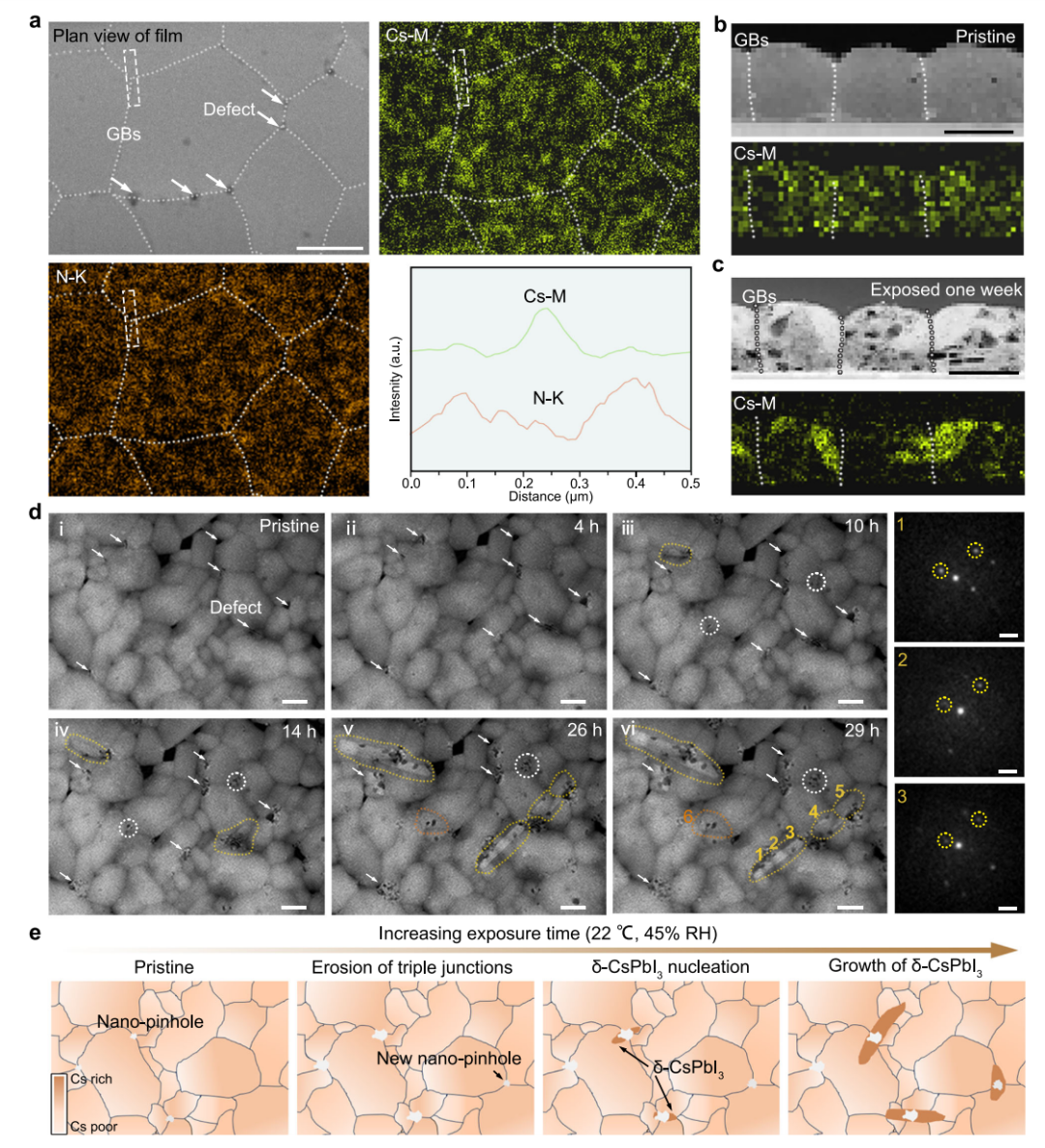
A collaboration led by Prof. Songhua Cai and Prof. Jun Yin (PolyU), together with CCRS member Prof. Yuanyuan Zhou (HKUST, Σ Lab), has traced for the first time at nanometre resolution where FA–Cs mixed-cation perovskites begin to fail. Using low-dose, quasi-in-situ STEM-EELS, the team identified caesium-rich triple junctions as the preferred entry points for water and oxygen. Intrusion there cleaves the lattice along the (001) plane and nucleates optically inactive δ-CsPbI₃, which then spreads across neighbouring grains.
Quasi-in-situ imaging captured the degradation sequence hour by hour: layered cleavage within the first hour, octahedral collapse into disordered low-dimensional clusters by the second, and δ-CsPbI₃ formation by the fourth. First-principles calculations and molecular-dynamics simulations explain why degradation nucleates there: Cs–O bonds are shorter than FA–O bonds, so Cs-rich surfaces adsorb a denser water layer and suffer greater Pb–I bond-length dispersion, making those boundaries preferentially hydrolysable.
To close this pathway, the team introduced N-octylsulfobetaine (NOST), a zwitterion whose dual oxygen donors chelate Cs⁺ in the precursor. NOST homogenises cation distribution across grains and, being bulky, self-assembles at grain boundaries as a hydrophobic passivation barrier. Forty days of ambient exposure left the control film fully degraded; the NOST-treated film showed almost no loss in absorption or phase purity. The resulting n-i-p devices reached 26.37% power conversion efficiency and retained 96.47% of initial performance after 2,200 hours under ISOS-L-1I, with cation distribution still uniform and no degradation products detected. The work reframes perovskite instability as a local, composition-driven phenomenon and shows that cation uniformity—not merely bulk composition—is a design parameter for durable devices.