Hong Kong, 14 October 2026, The 20th Logistics and Supply Chain Management (LSCM) Summit, themed "Linking Minds, Empowering Innovation," provided the stage for OceanNEX to present its subseasonal-to-seasonal (S2S) prediction model to a cross-sector audience of logistics professionals, researchers, and technology developers.
OceanNEX addresses a persistent operational gap: today's weather forecasts provide only 3–5 days of notice, far too short for ports and shipping lines to prepare for typhoons, storm surges, or persistent sea fog. By the time an alert arrives, berths are assigned, cranes committed, and vessels mid-voyage, forcing costly last-minute decisions. Subseasonal prediction, spanning roughly 7 to 30+ days, bridges short-range forecasts and seasonal outlooks, offering the multi-week horizon needed to schedule arrivals, manage cargo, adjust staffing, and coordinate transport.
OceanNEX delivers decision-grade typhoon, storm surge, and extreme weather intelligence within this window of measurable physical predictability, helping ports shift from reactive closures to proactive, science-informed planning. The exhibition was framed under the theme "Seamless Weather to Climate Prediction for Resilient Port and Shipping Operations."
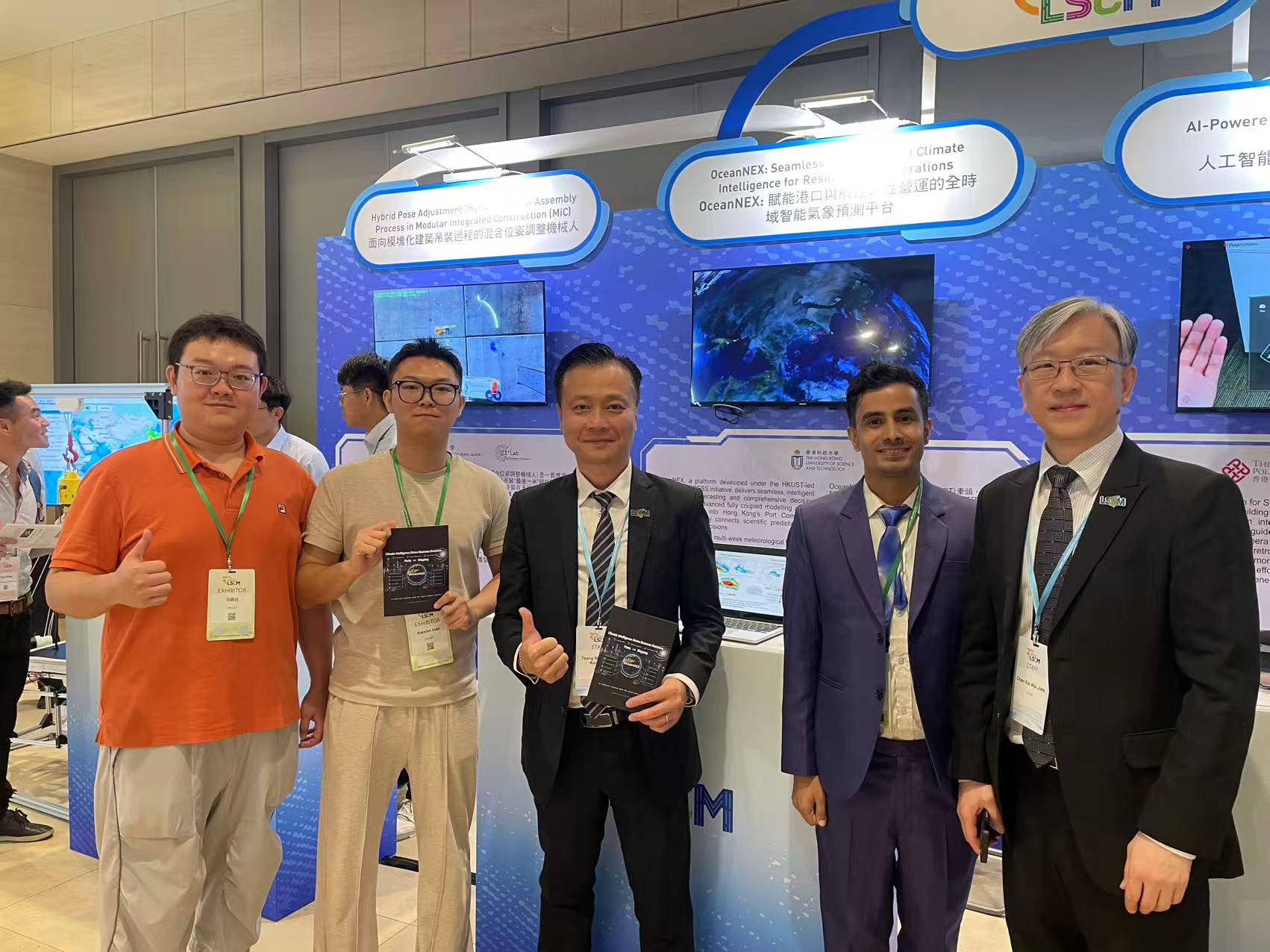
At the event, Dr Dipendra Lamichhane, Forecast Scientist with the research group led by Professor Mengqiu Lu at The Hong Kong University of Science and Technology (HKUST), presented the OceanNEX model. He outlined the full decision chain from forecast to action, showing how raw forecast data is refined, interpreted, and translated into actionable guidance for real-world port and shipping operations. Rather than stopping at meteorological outputs, the session showed how probabilistic signals are converted into operational choices: when to adjust berth allocations, how to sequence vessel arrivals, where to pre-position equipment, and how to build buffer time into tightly synchronized schedules.
The presentation drew strong and sustained interest from representatives across multiple sectors. Attendees included representatives from the Hong Kong International Aerospace; multiple members from the Logistics and Supply Chain MultiTech R&D Centre Limited; and Orient Overseas Container Line Ltd. (OOCL); all of whom engaged actively with the OceanNEX team during and after the session, probing the model's lead-time performance, its handling of typhoon risk, and its potential integration into existing port and fleet planning workflows. Their questions reflected a practical orientation: not simply whether the science works, but how it can be embedded into day-to-day operational decision-making.
Alongside these institutions, numerous other participants from diverse sectors spanning terminal operations, shipping lines, supply chain technology, and academic research visited the OceanNEX exhibit, sparking wide-ranging discussions on the model's applications and its potential to reshape how the industry plans around weather risk. The strong turnout and depth of engagement underscored a growing consensus: subseasonal forecasting is a scientific necessity for modern logistics. As climate variability intensifies and supply chains face mounting pressure, OceanNEX offers the multi-week foresight needed to keep global logistics moving safely, efficiently, and proactively.