On December 8, 2025, HKUST—together with Tsinghua University, Nanjing University, and Tianjin University—formally established the Chinese University Alliance of Earth System Science (CUAESS) at Tsinghua University. The Alliance was founded following years of discussions and exchanges among key partners, including Prof. LU Mengqian, Director of the Otto Poon Center for Climate Resilience and Sustainability (CCRS). Prof. Lu played a central role in the formation of CUAESS and will lead its Global Collaboration and Engagement, building on HKUST’s internationally recognized leadership in climate research, including its role in the UNESCO-endorsed, WWRP-partnered International Decade of Sciences for Sustainable Development program, Seamless Prediction and Services for Sustainable Natural and Built Environments (SEPRESS).
During the inauguration ceremony, founding CUAESS President Prof. CHEN Deliang of Tsinghua University introduced the mission and vision of CUAESS as a global platform dedicated to advancing Earth system science and fostering high-impact international collaboration.
The ceremony and panel discussions brought together leading scholars in the field, including 11 Academicians from the Chinese Academy of Sciences and the Chinese Academy of Engineering.
During the panel on the expected role and responsibilities of CUAESS—chaired by Prof. DING Aijun of Nanjing University—Academician LIU Congqiang, Dean of the School of Earth System Science, emphasized that the establishment of CUAESS marks an important step for Earth System Science toward a new paradigm centered on “harmonizing the human–Earth relationship.” He noted that the Alliance will promote interdisciplinary and cross institutional collaboration, develop mechanisms for resource sharing, and enhance the efficient use of scientific resources as well as the dissemination of academic outputs. Academician GUO Yike, Provost of HKUST, highlighted that Earth System Science embodies a modern scientific expression of the traditional concept of the unity between humanity and nature. Looking ahead, he remarked that artificial intelligence will play an increasingly transformative role in the field, calling for deeper exploration of AI’s potential to build intelligent systems capable of safeguarding the planet. Academician CHEN Deliang noted that the Alliance should uphold strong interdisciplinary integration and leverage advances in observation and modeling technologies to deepen understanding of Earth system processes, thereby providing robust scientific support for sustainable development, while Academician FU Congbin stressed that the Alliance must take a leading role in becoming not only a platform for collaboration but also an innovation community that breaks disciplinary boundaries, enables deep integration and dynamic responsiveness, and serves as a catalyst for new scientific paradigms, talent development, and actionable solutions for sustainability.
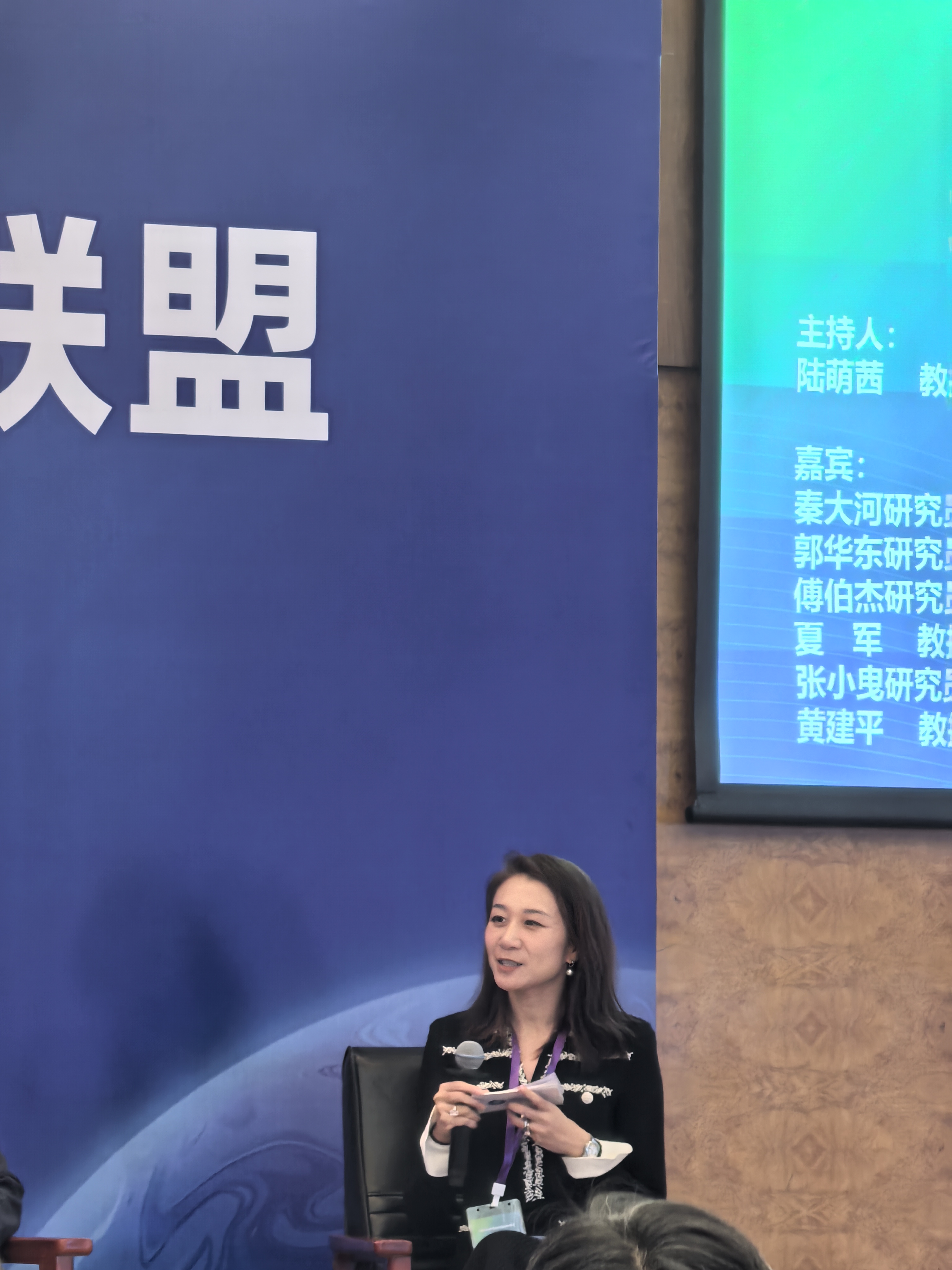
In the subsequent panel on the opportunities and challenges for the future development of Earth System Science—chaired by Prof. LU Mengqian—six Academicians from both the sciences and engineering participated in a forward-looking discussion on the future of Earth System Science and the importance of its interdisciplinary foundations.
- Academician QIN Dahe reminded the audience that Chinese scientists have played a pivotal role in the Intergovernmental Panel on Climate Change (IPCC) assessment reports. He expressed his expectation that the Alliance will deliver substantive impact and provide strong scientific support for the sustainable development of the coupled human–Earth system.
- Academician GUO Huadong emphasized that developing “Digital Earth” as a precise simulator of the Earth system—realizing the vision of “placing the Earth inside a computer”—is essential for future scientific advancement. He noted that the Alliance should uphold a systems-thinking approach and help elevate Earth System Science in China and around the world.
- Academician FU Bojie stressed that, as an inherently interdisciplinary field, Earth System Science must integrate geographical thinking with atmospheric and systems-science methodologies, while advancing coupled ecological–economic process modeling to support its long-term development.
- Academician XIA Jun pointed out that the water cycle serves as a core connector across Earth’s spheres. He highlighted that future progress will require addressing major scientific challenges, including nonlinear spatiotemporal variability, multi‑media biogeochemical processes, and coupled hydrological–human system interactions.
- Academician ZHANG Xiaoye shared insights from his IPCC AR7 experience and linked them to the future development of CUAESS, noting that Chinese scientists are working to develop more realistic emissions‑scenario pathways. He called on the Alliance to attract and empower young scientific talent and to guide Earth System Science toward greater integration and higher scientific ambition.
- Academician HUANG Jianping mentioned that insufficient simulation capability in semi‑arid regions has become a major bottleneck for advancing Earth System Science under intensifying global climate challenges. He emphasized that overcoming this gap will require innovations in observational technologies, deeper fusion of artificial intelligence with high‑performance computing, and strengthened interdisciplinary collaboration.
Prof. Lu Mengqian stated that the Otto Poon Center for Climate Resilience and Sustainability is exploring interdisciplinary integration across fields such as finance, humanities, atmospheric science, and hydrology. The goal is to establish a comprehensive research framework that connects Earth system science with social and economic systems.
During the event, representatives from top universities expressed strong support for the establishment of CUAESS and emphasized its expected role in advancing Earth System Science to support climate resilience and global sustainability.